The Mumbai Local game is a first-person courier survival experience set on Mumbai's suburban railway, and it is being prepared for a Steam launch. You do not drive the train. You stand on the platform with a parcel, read the indicator, decide whether the arriving service will stop where you need it, judge which coach has room, and try to deliver before the city turns your route into a story.
That distinction matters because the title sits close to a crowded field of mobile train-driving simulators. The official Mumbai Local page from noskills.studio leads with the clearer fantasy: “Miss the train. Not the deadline.” Its Steam page is not live yet, and no public release date has been announced. What is public today is the premise, the current in-engine build, the target platforms, and a surprisingly detailed railway simulation underneath the low-poly presentation.
bunpav's take: Mumbai Local has the kind of specific, locally legible idea Indian games need more of. It is not “an Indian skin on a familiar genre.” The fast/slow confusion, open doors, packed coaches, rain-soaked platforms, station codes, food stops, and running-board decisions are the mechanics. The opportunity is huge if the team can make that density readable to players who have never taken a Mumbai local.
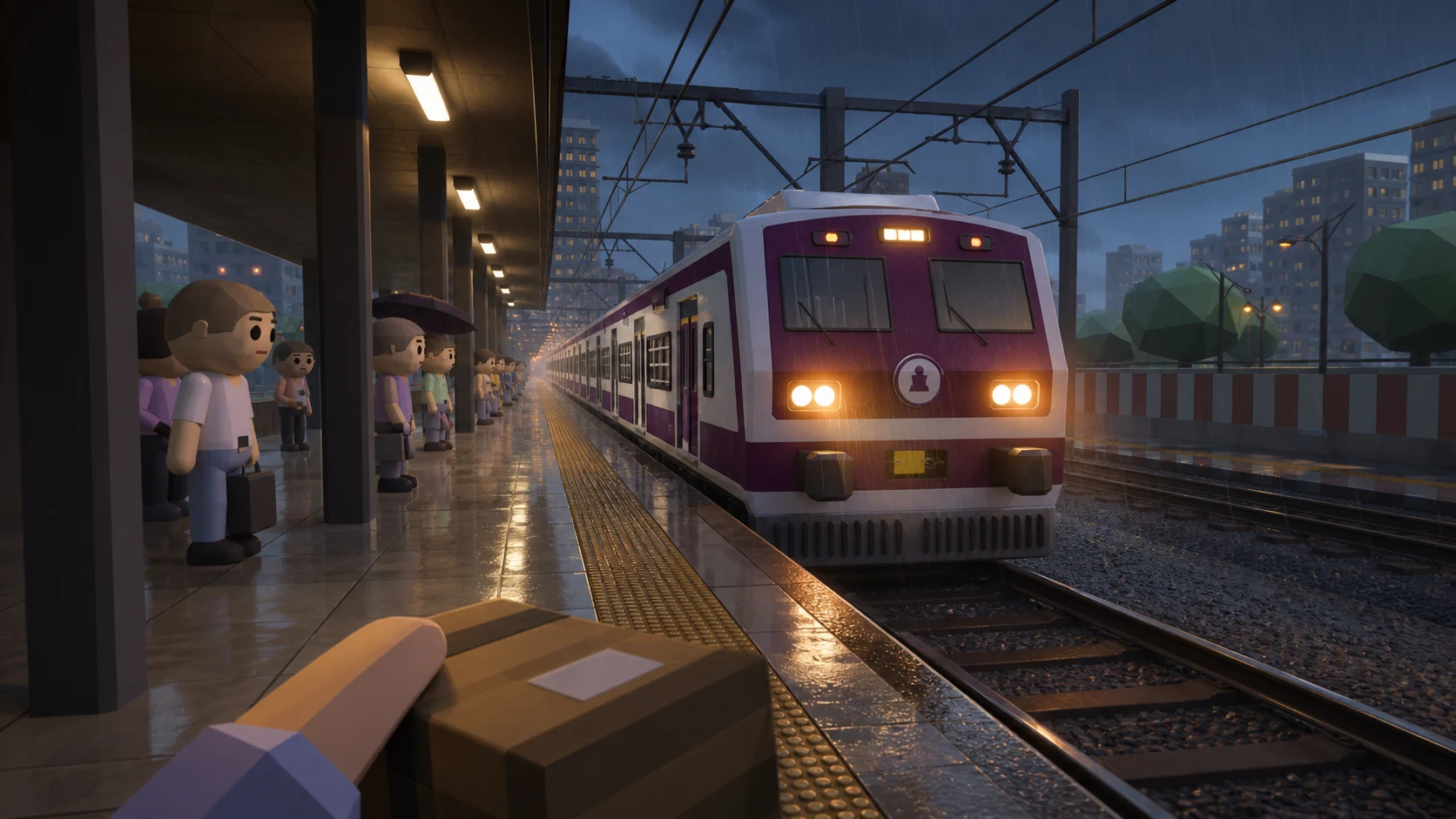
The announcement artwork is built from Mumbai Local's current visual direction; the gameplay captures below are from the in-development Godot build.
What is the Mumbai Local game? The short answer
| Question | Direct answer |
|---|---|
| What kind of game is it? | First-person railway courier survival, not train driving. |
| What do you do? | Accept parcels, read train indicators, pick a coach, ride, manage your condition, and deliver on time. |
| Where is it set? | A connected interpretation of Mumbai's suburban railway. |
| Network size? | The current build materials describe 124 stations and 1,706 services in a living day. |
| Is there a release date? | No public date yet. The Steam page is coming soon. |
| Planned desktop platforms? | Windows, macOS, and Linux through Steam; a free web demo is also planned. |
| Engine? | Godot 4.7, with a desktop renderer and a compatibility path for the planned web demo. |
| Multiplayer? | Solo is the complete default game; optional online rooms are part of the development plan. |
The numbers are worth timestamping. They describe the checked-in game and launch plan as of September 1, 2026. Store scope, platform labels, and feature wording can change before Valve's page goes public.
The premise: your uncle's route, your working day
Mumbai Local begins with inheritance rather than heroism. Your uncle carried parcels along the railway for decades. Station staff, cake shops, and delivery houses knew him. When he is gone, he leaves you his satchel, his route, and his debt.
The fiction gives an endless systems game a human first step. The 6:03 slow becomes the alarm clock. The platform becomes the office. Progress is not about saving Mumbai or buying a faster train; it is about becoming a regular, earning standing station by station, and learning when an attractive job is actually a bad decision.
That framing also solves a problem many time-management games have. A deadline is mechanically useful but emotionally empty when it exists only as a shrinking bar. Here, the deadline belongs to a parcel somebody trusted you to move through a railway that follows its own clock. Missing the train is not a scripted failure scene. It changes the route that remains available.
The result is closer to a courier-life simulation than a conventional campaign. There are no announced cutscene-heavy story arcs or giant quest trees. Most of the narrative should come from systems colliding: rain slows the platform sprint, hunger makes the next job riskier, the fast train skips the station you needed, and an open doorway offers a terrible but tempting last chance.
How does Mumbai Local actually play?
The cleanest summary is read, run, ride.
1. Read the indicator
Mumbai locals are not one line of identical trains. Services can be fast or slow, terminate early, change platforms, or skip the stop that looks obvious on the map. The game uses familiar destination codes and indicator-board language rather than replacing the network with a single glowing quest arrow.
That does not mean it expects every player to arrive as a railway expert. The learning curve is the game. At first, “C F 4” is noise. Later, it is enough information to make a confident decision before the doors reach you.
This is where Mumbai Local separates itself from a map-management game such as Mini Metro. You are not viewing the network from above and optimising an abstract flow. You are standing below the board, looking down the platform, with first-person distance and time between you and the correct coach.
2. Run and choose a doorway
Once the service is right, the next question is where to board. Mumbai Local does not reduce an entire train to one floating occupancy number. Crowds are visible. Coaches have their own restrictions and risk. The player must read bodies, open doors, platform position, and the time left before departure.
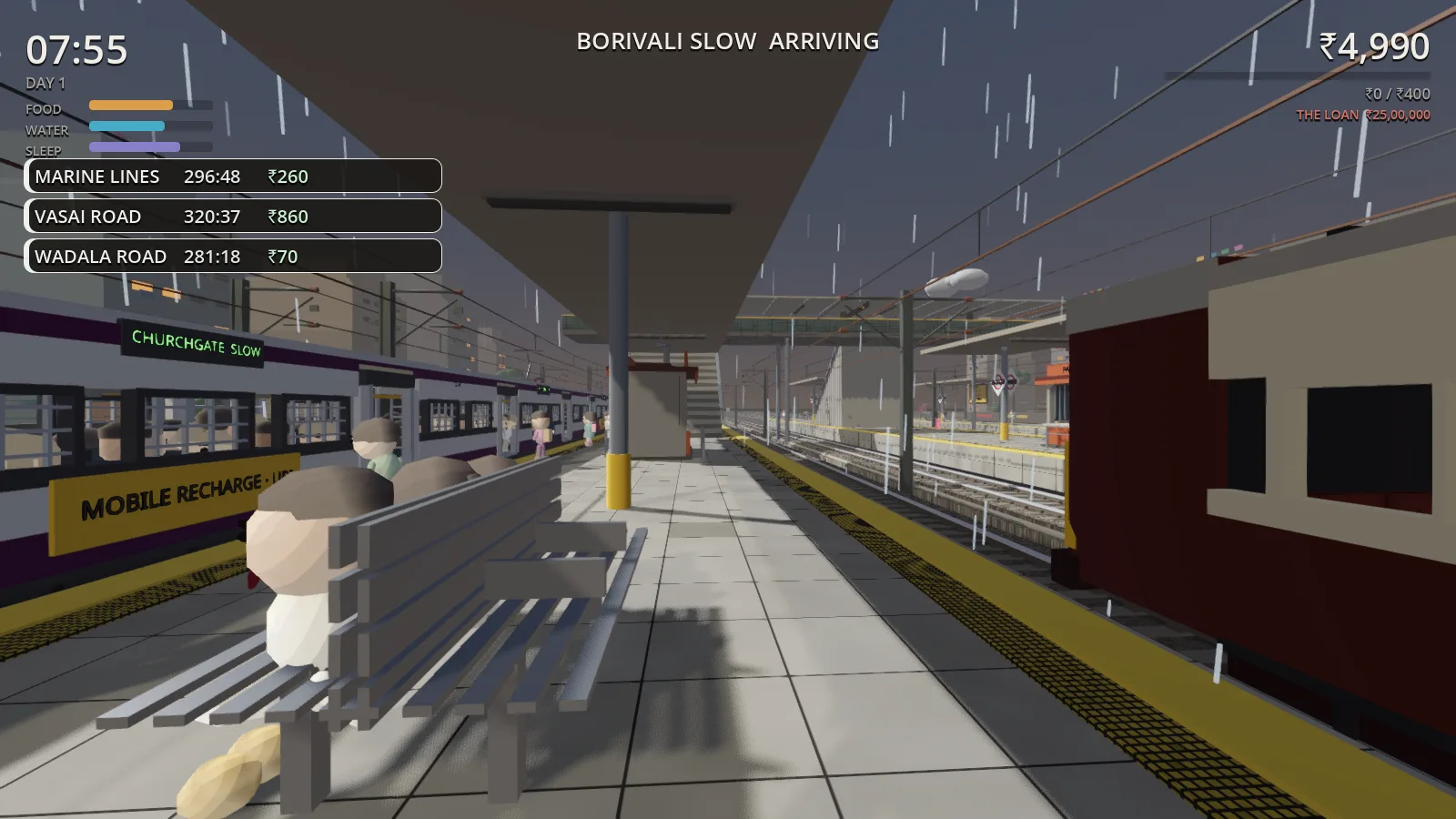
Current in-engine capture. Interface, lighting, crowd density, and balance remain work in progress.
This is the game's most promising source of short-form tension: the four seconds between recognising your train and believing you can still make it. Denshattack's train-skating hook works because one clip explains the fantasy immediately. Mumbai Local needs a different but equally legible clip—a parcel in hand, the correct train moving in, a crowded doorway, and one desperate decision.
3. Ride instead of teleporting
Boarding does not turn the railway into a loading screen. The ride is playable time. You can stand inside the coach or near an open doorway, watch the corridor move past, protect what you are carrying, manage where you will exit, and avoid missing your stop.
That slower middle beat matters. Constant sprinting would flatten the game into noise. The ride gives pressure somewhere to fall, then lets the next station build it again. It also makes weather, lighting, trackside scenery, station architecture, vendors, passengers, and coach details part of the game rather than background art seen only in a trailer.
What makes it survival rather than a delivery simulator?
The courier has needs that continue across the working day. Food, water, sleep, and frustration are separate pressures rather than one generic energy bar. Eating does not solve thirst; drinking does not remove exhaustion; a seat can help while introducing its own risks if the courier naps through the wrong part of a route.
Cash also has more jobs than “score goes up.” Fares, food, water, penalties, debt, and parcel rewards all compete for the same balance. A high-paying delivery can be unattractive when it pushes the courier onto a crowded rush-hour route with no recovery time. The useful decision is not always the job with the largest rupee number.
That gives Mumbai Local some immersive-sim texture without promising the enormous authored possibility space usually associated with that label. The systems are narrow but connected:
- train time affects delivery time;
- crowding affects boarding and where you can stand;
- weather changes visibility and the feel of the platform;
- food, hydration, sleep, and frustration alter how long the courier can keep making good decisions;
- fares and purchases reshape the day's cash;
- missing a service changes every connection after it.
The game will live or die on tuning. If needs drain too quickly, the railway fantasy becomes bar maintenance. If deadlines are too forgiving, the platform decisions lose their teeth. The current build is substantial enough to show the intended loop, but a Steam page is not the same as a finished balance pass.
How real is the railway network?
The current content pack describes 124 stations and 1,706 scheduled services moving through one living day. Trains run whether the player is present or not. Fast and slow patterns share infrastructure; services can wait, cross, arrive, depart, and turn around according to the simulation rather than spawning solely for the next objective.
Those figures sound like a claim of one-to-one photorealism. They are not. Mumbai Local uses a stylised low-poly art direction and reusable station architecture kits. The goal is systemic and cultural recognition: the route logic, boards, coach distinctions, open doors, platform rhythm, rain, crowd behaviour, and city texture should read correctly even when every tile is not a laser-scanned replica.
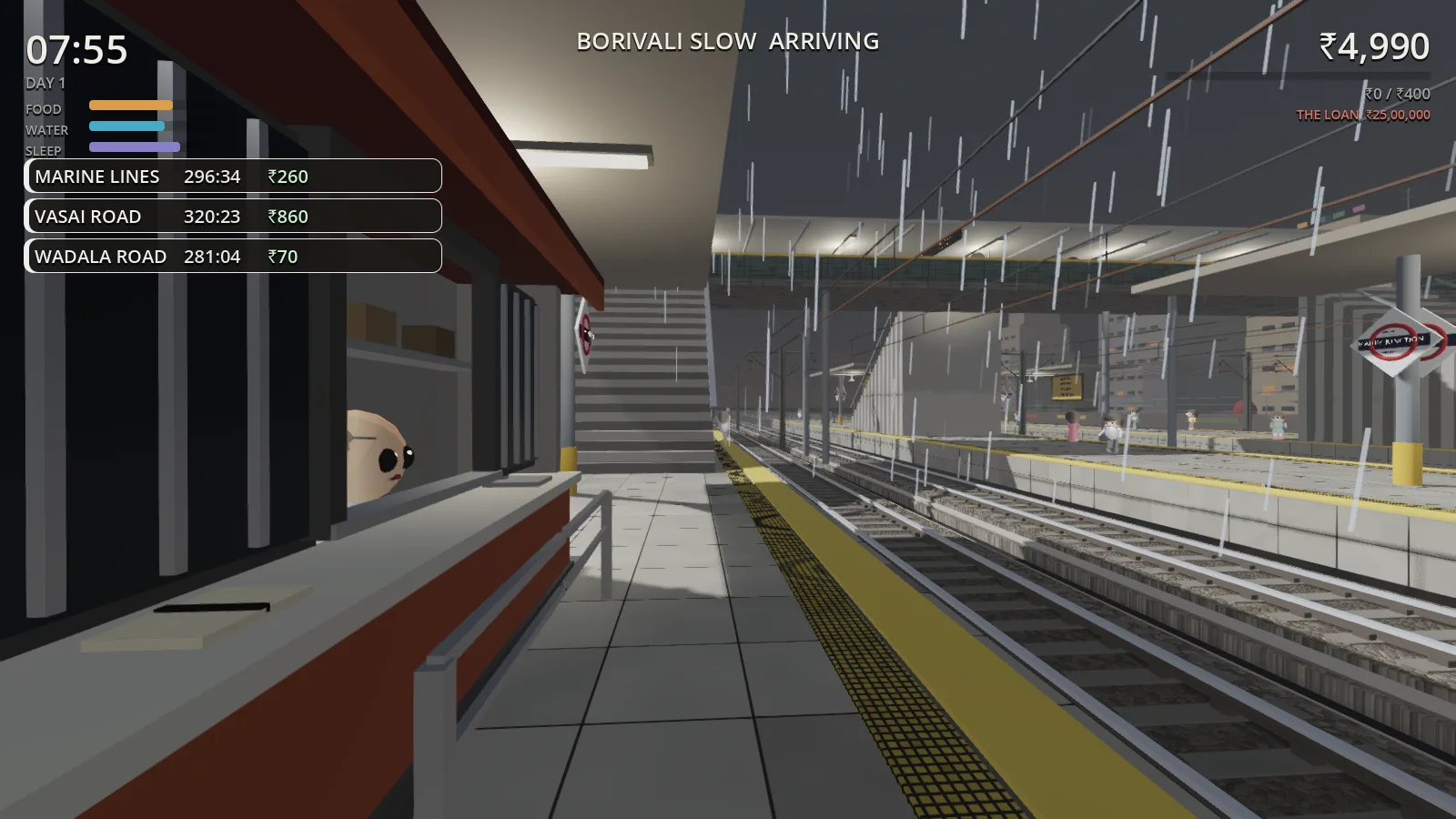
The current build uses visible platform crowds instead of one abstract train-wide occupancy meter.
That approach is strategically sensible for a small studio. A handcrafted 124-station photoreal railway would be an impossible content burden. Data-driven world packs and reusable kits let the team spend its highest-detail effort where players get close: train fronts, doorways, coach interiors, indicator boards, vendors, hands, parcels, and the platform geometry that determines a boarding decision.
It also places Mumbai Local in an interesting corner of the current Indian game wave. Unleash the Avatar, Raji: Kaliyuga, Son of Thanjai, Mukti, and The Age of Bhaarat largely sell myth, history, action, or narrative spectacle. Mumbai Local sells everyday infrastructure. Its cultural specificity comes from an ordinary commute made mechanically dense.
Is Mumbai Local single-player or multiplayer?
The safest answer is: the game is designed to be complete solo. It boots into a personal courier run, not a mandatory lobby. The development plan also includes opt-in online rooms where nearby couriers can be present, communicate, and share the same railway time, but multiplayer is not supposed to replace the single-player simulation.
That boundary is healthy. Small online games can become unplayable when population falls below the number their core loop assumes. A complete solo foundation lets multiplayer add social stories without becoming a server-population requirement.
Until the Steam page publishes a final feature list, treat rooms, voice, cross-platform behaviour, and player counts as development targets—not purchasing facts. The official announcement page correctly avoids advertising a specific lobby size today.
What is confirmed about the Steam launch?
Three things are clear:
- The game is called Mumbai Local. The older working title “LOCAL” has been retired from the current launch identity.
- The Steam page is coming soon. There is no public store URL or announced release date yet.
- The planned desktop targets are Windows, macOS, and Linux. A free compatibility-renderer web demo is also in the plan.
Everything more precise should wait. There is no honest countdown, live wishlist number, price, public demo date, Next Fest appearance, Steam Deck rating, or final launch-day feature list to report yet. “Coming soon” is useful news; it is not permission to fabricate a month.
This is the same evidence discipline bunpav applies to other unreleased Indian games. A developer target is not a release date, a plan item is not a shipped feature, and a beautiful composition is not an in-engine screenshot. The three gameplay images in this post are labeled separately for that reason.
Why Mumbai Local could stand out on Steam
Steam has many train games and many delivery games. Most train games put the player in a cab or above a management map. Most delivery games use roads, walking, or vehicles as traversal between objectives. Mumbai Local's strongest idea is to make being a passenger the skill.
That gives it several advantages:
- An immediately recognisable setting for millions of Mumbaikars.
- A fresh role for global train-game players who have already driven locomotives and designed networks.
- A clip-readable decision when a crowded open-door train is about to leave.
- A systemic structure where timetables, needs, cash, weather, and deadlines can create stories without scripted quests.
- A realistic indie scope trade-off through stylised art and data-driven stations rather than photoreal city reconstruction.
The risk is readability. Local knowledge can feel like mastery to one player and unexplained punishment to another. Mumbai Local must teach indicator codes, fast/slow services, coach choices, and station geography without sanding away the confusion it wants players to learn. That onboarding problem is harder than adding another tooltip.
The second risk is presentation consistency. The monsoon hero image communicates atmosphere more strongly than some current gameplay captures. Steam customers will compare capsule art with unedited play immediately. The build needs its best train front, crowd, rain, platform, and lighting work visible during normal play—not only in marketing frames.
Verdict: a distinctly Mumbai game with a clear mechanical identity
Mumbai Local is compelling because its place and its verbs are inseparable. Reading a fast-service code, walking down a crowded platform, eating at the right time, choosing a coach, standing at an open doorway, and watching rain move across a living timetable are not decorative authenticity. They are the game.
It is also still in development. The Steam page has not opened, the release date is unknown, and some ambitious launch features remain planned rather than store-confirmed. Players should follow the official noskills.studio Mumbai Local page for the real wishlist link when it appears.
For now, the honest pitch is enough: Mumbai Local is a first-person railway courier survival game in which missing one train can rearrange the rest of your day. If the final build makes that consequence readable, tense, and occasionally beautiful, it will occupy a Steam niche that no driver simulator currently fills.
Related reading
- 10 games like PEAK — co-op climbing, physics chaos, and one railway wildcard
- Unleash the Avatar and the Indian studios building the next wave
- Denshattack — the train-skating indie hit
- Hop.Earth generates real roads in a browser game
- How indie developers use AI 3D props to fill levels
- The game-jam 3D asset pipeline
- Mumbai Local — official game page
Game scope, screenshots, platform targets, and Steam status were checked against the current Mumbai Local project and launch materials on September 1, 2026. The Steam page and public release date were not live at publication; planned features can change before launch.