Primitive Lab · live in beta
A procedural 3D asset studio, right in your browser
Browse a 61-asset parametric library spanning vehicles, animals, trees, characters, rocks, nature, props, and platforms. Dial in geometry with sliders, pick a material and palette, and export a game-ready GLB — deterministic and free while in beta.
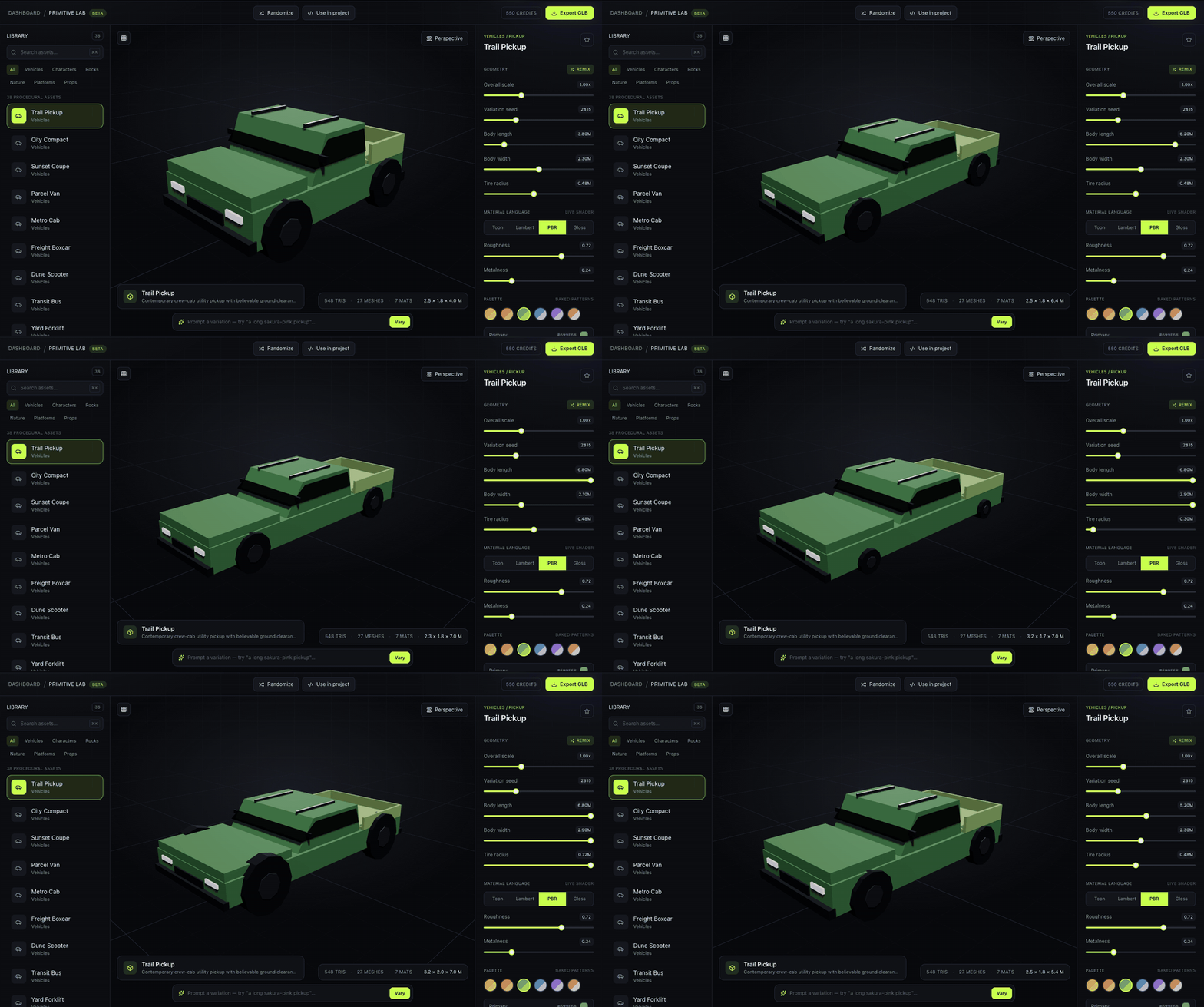
how it works
From library to importable mesh in four steps
1. Pick an asset from the library
61 procedural assets across vehicles, animals, trees, characters, rocks, nature, props, and platforms — searchable, filterable by category, favoritable for quick recall.
2. Dial in the geometry
Every asset exposes 2–4 sliders — body length, jaggedness, tire radius, spire height — plus an overall scale and a variation seed for reproducible silhouettes.
3. Choose materials and palette
Toon, Lambert, PBR, or Gloss shading with live roughness/metalness, six built-in palettes, or your own primary/secondary/accent hex colors.
4. Export and drop it in
One-click binary GLB export, or copy a ready GLTFLoader snippet — pivot-correct and resting on the ground plane, no cleanup pass required.
Deterministic by construction
Every build is seeded through a mulberry32 PRNG — the same asset ID, seed, and slider values always produce byte-identical geometry. Share a seed instead of a file: teammates rebuild the exact same mesh locally.
Vertex-welded deformation
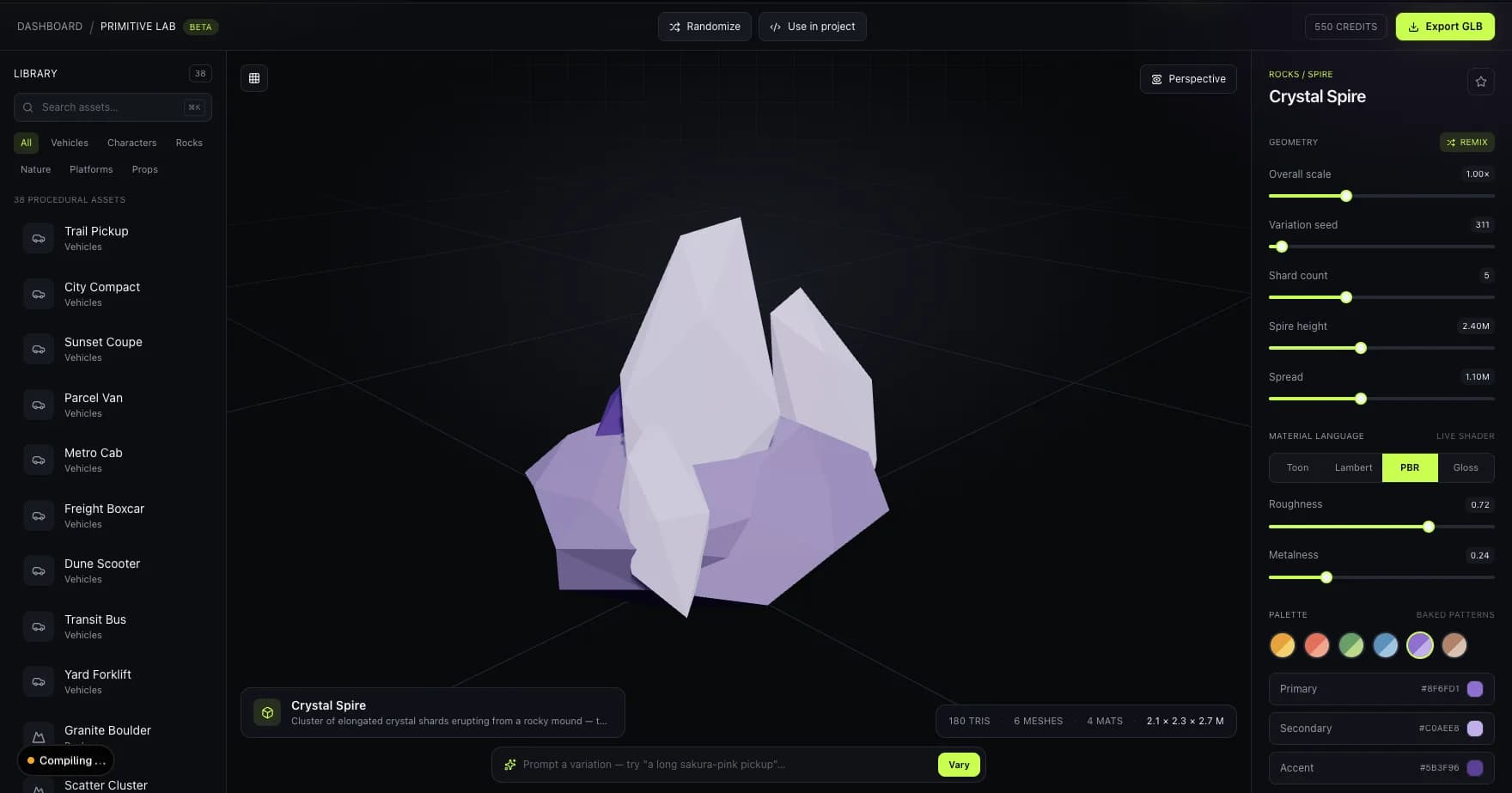
Sloped cab roofs, tapered spires, and rockified boulders are built by displacing existing vertices as a pure function of position — not by re-triangulating — so duplicated corner vertices move identically and nothing tears at the seams.
Palette-role materials, not hardcoded colors
Each mesh part is tagged with a role (primary, secondary, accent, glass, metal, glow) rather than a fixed color. Swapping a palette recolors the whole asset in one pass, and custom hex overrides apply the same way.
Export-ready pivots
Every asset is generated centered on its own origin and rests exactly on y = 0, with dimensions reported in real-world metres — the two most common reasons a downloaded 'game-ready' asset needs a cleanup pass before it behaves correctly in an engine.
the library
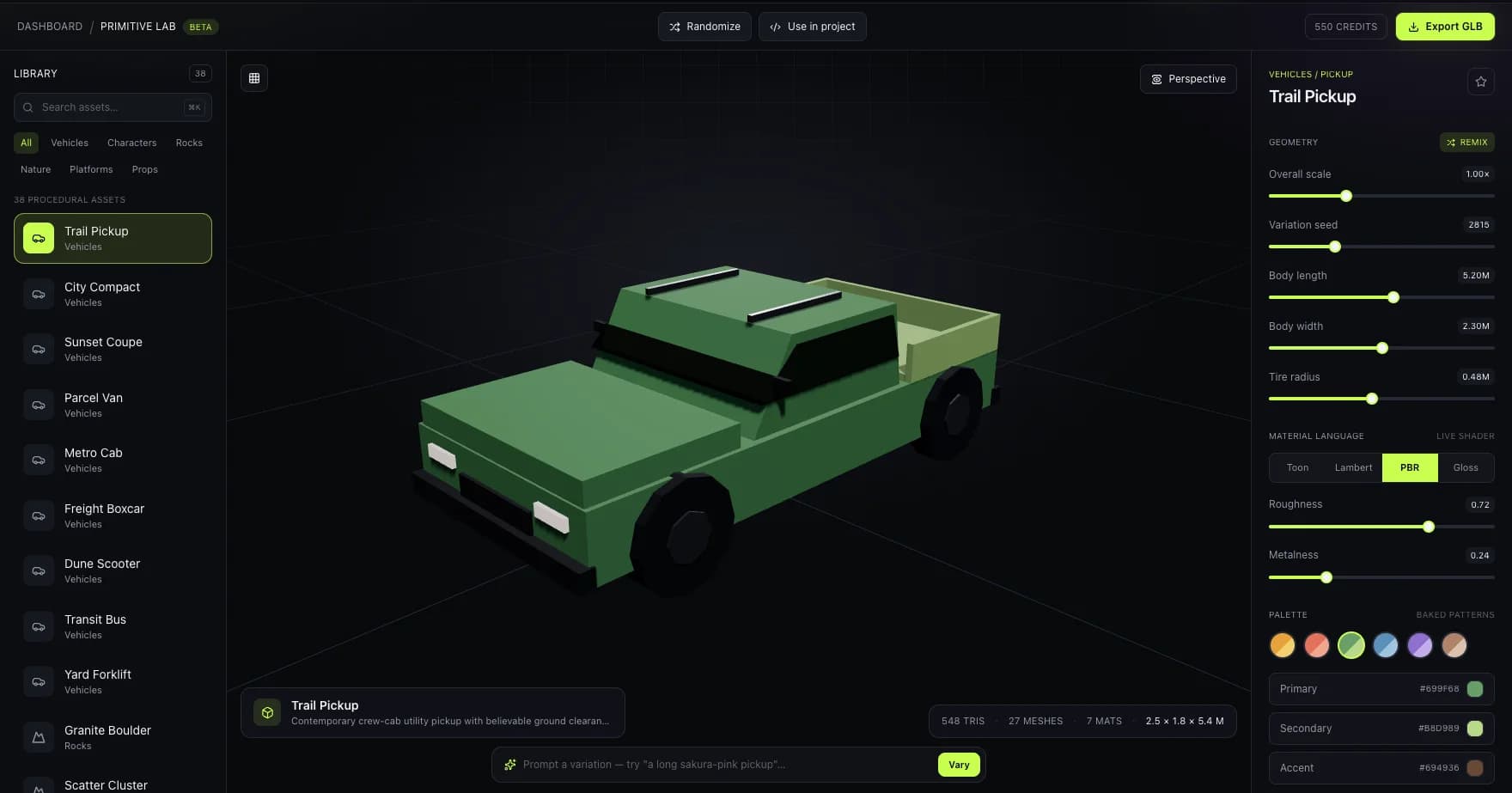
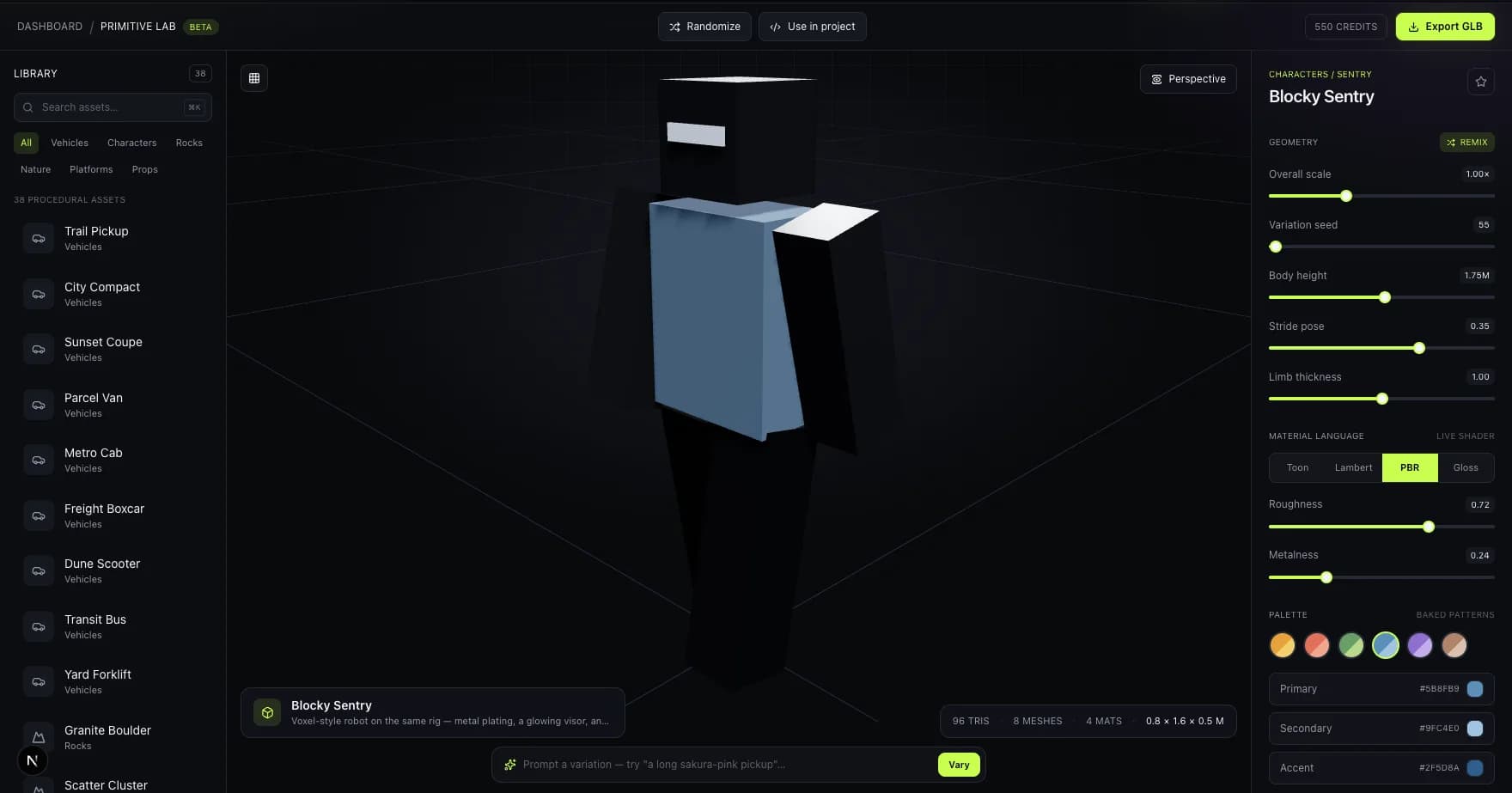
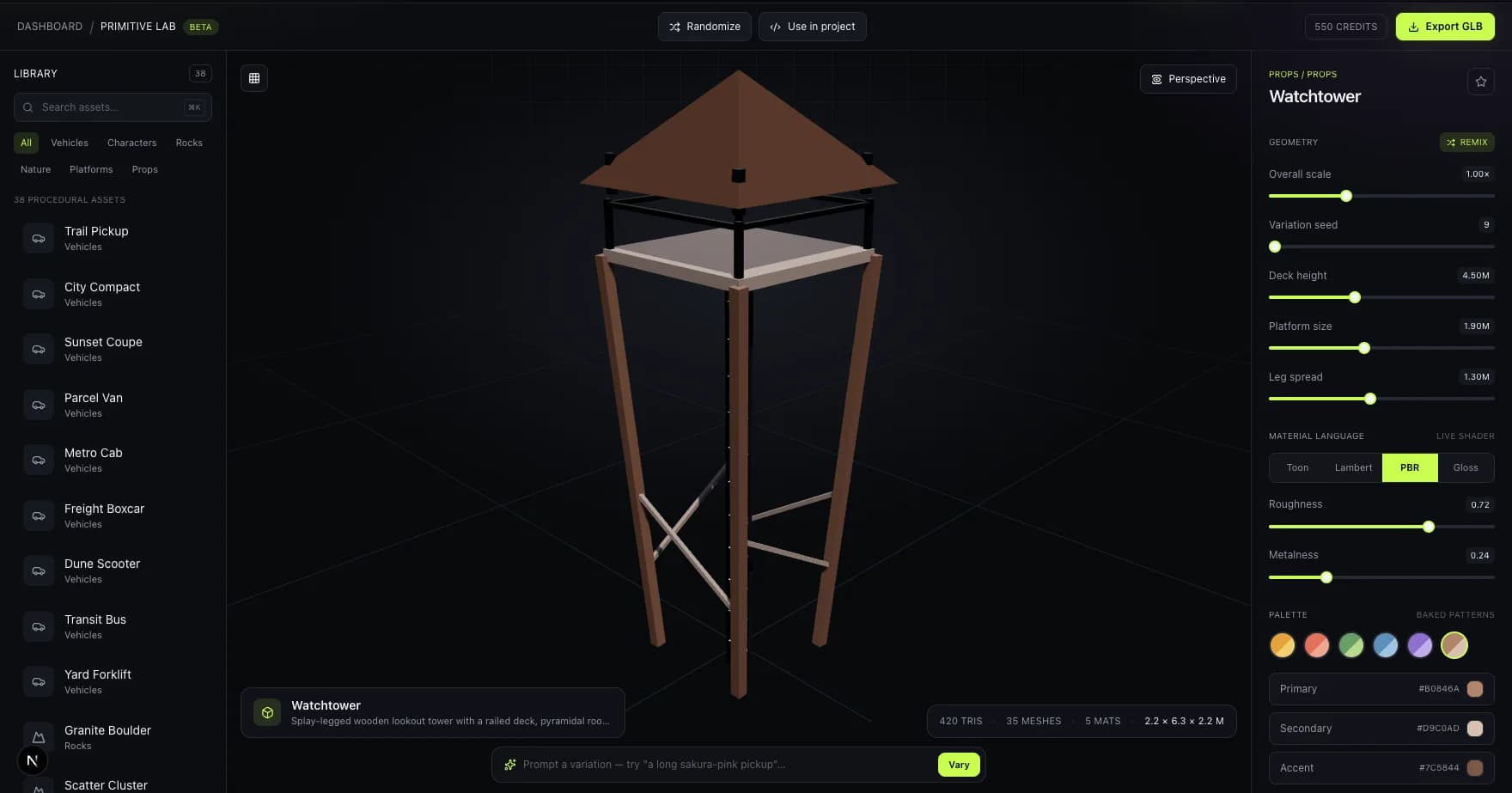
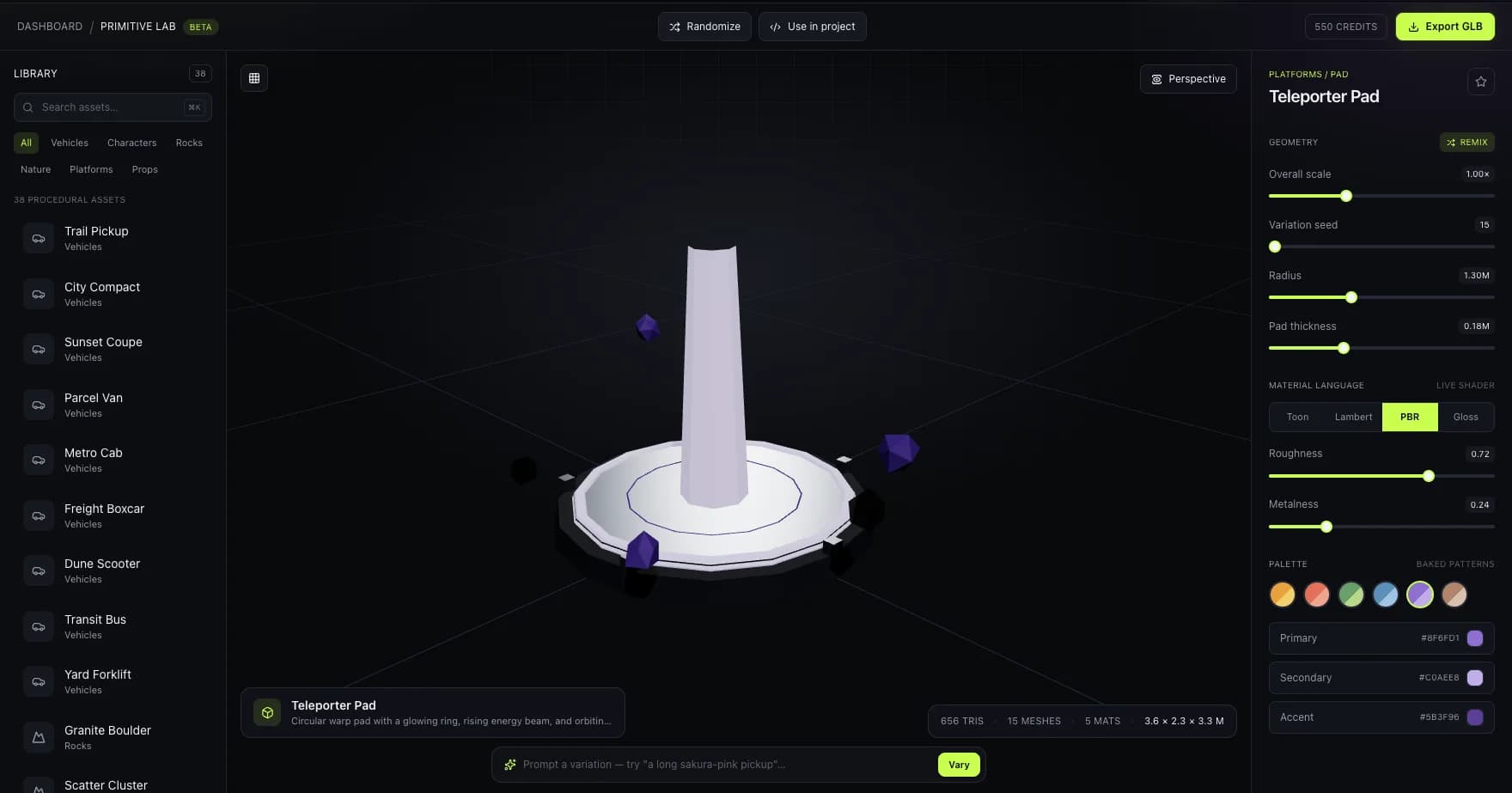
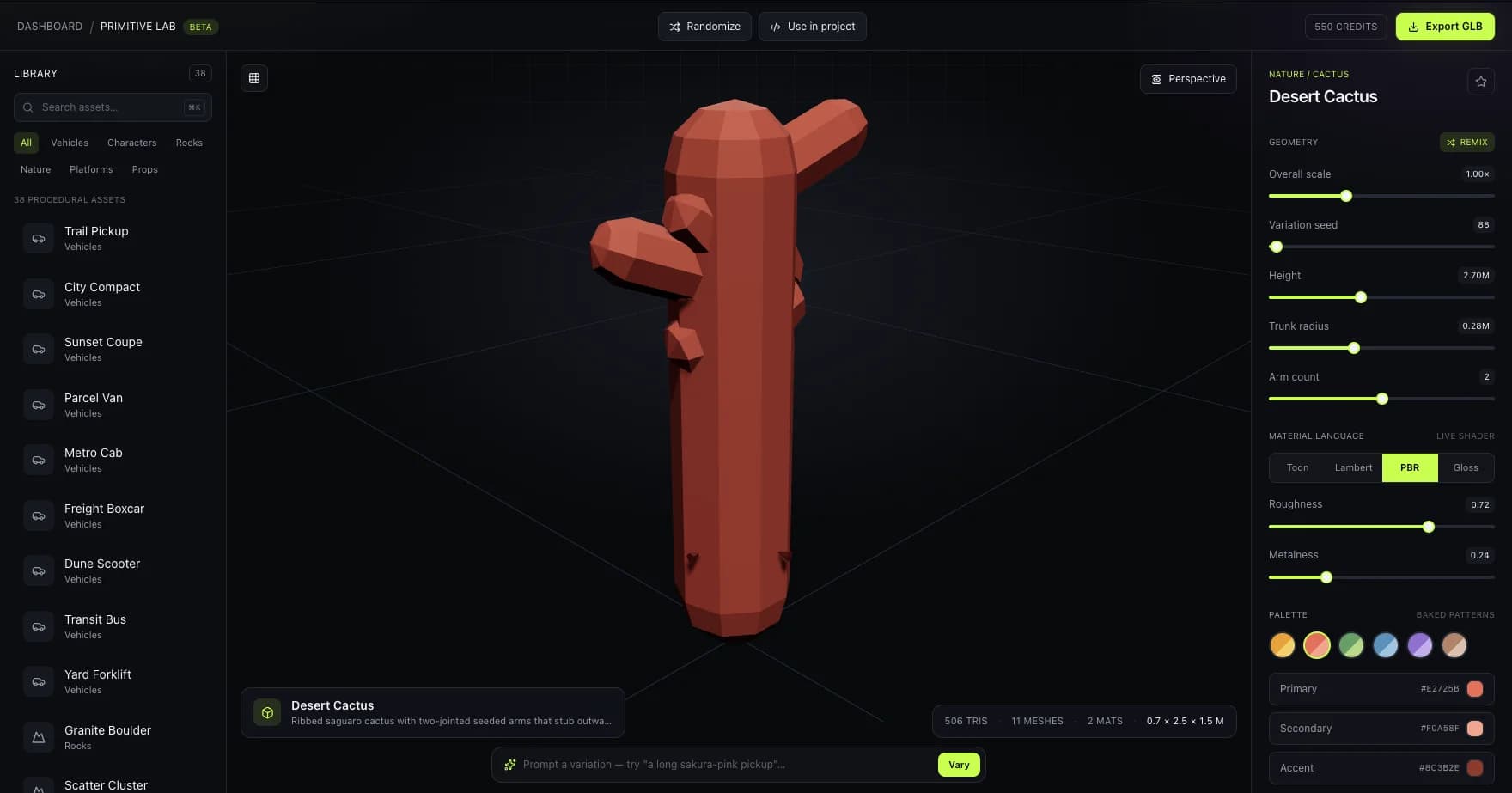
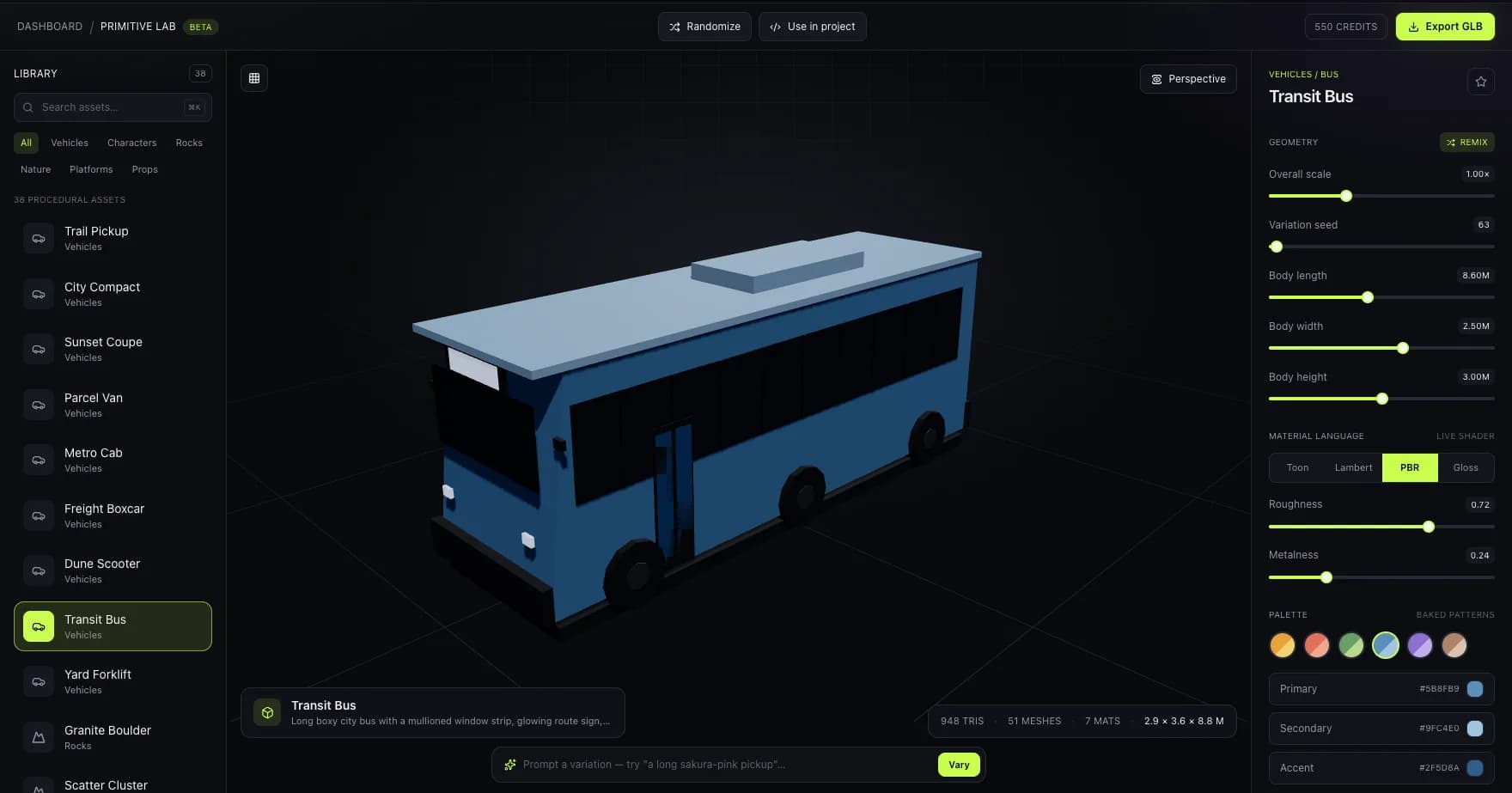
Six categories, real screenshots, every one live right now
Not mockups — these are actual captures of the studio rendering each asset category.
procedural vs. AI
When to use Primitive Lab vs. text/image-to-3D
Both are bunpav tools — they solve different problems. A common workflow is to block out a level entirely in Primitive Lab, then replace one or two hero assets with a custom text-to-3D or image-to-3D generation.
| Feature | Primitive Lab | Text/Image-to-3D |
|---|---|---|
| Output speed | Instant — sliders rebuild in milliseconds | Seconds to a minute per generation |
| Reproducibility | Exact — same seed always rebuilds identically | Approximate — re-prompting gives a new result |
| Cost | Free, unlimited while in beta | Spends bunpav credits per generation |
| Best for | Vehicles, props, terrain, level kits, placeholders | One-off custom or hero assets from a description or photo |
| Customization | Named sliders (length, radius, jaggedness…) | Re-prompt or provide a different reference photo |
| Style control | 6 palettes + custom hex, 4 material modes | Follows the prompt or source image's style |
who it’s for
Built for teams that need coverage fast
Game jams & rapid blockout
Fill a level with real, textured vehicles and props in minutes instead of grey boxes — pick an asset, tune it, export, move on to the next system.
Prop and environment libraries
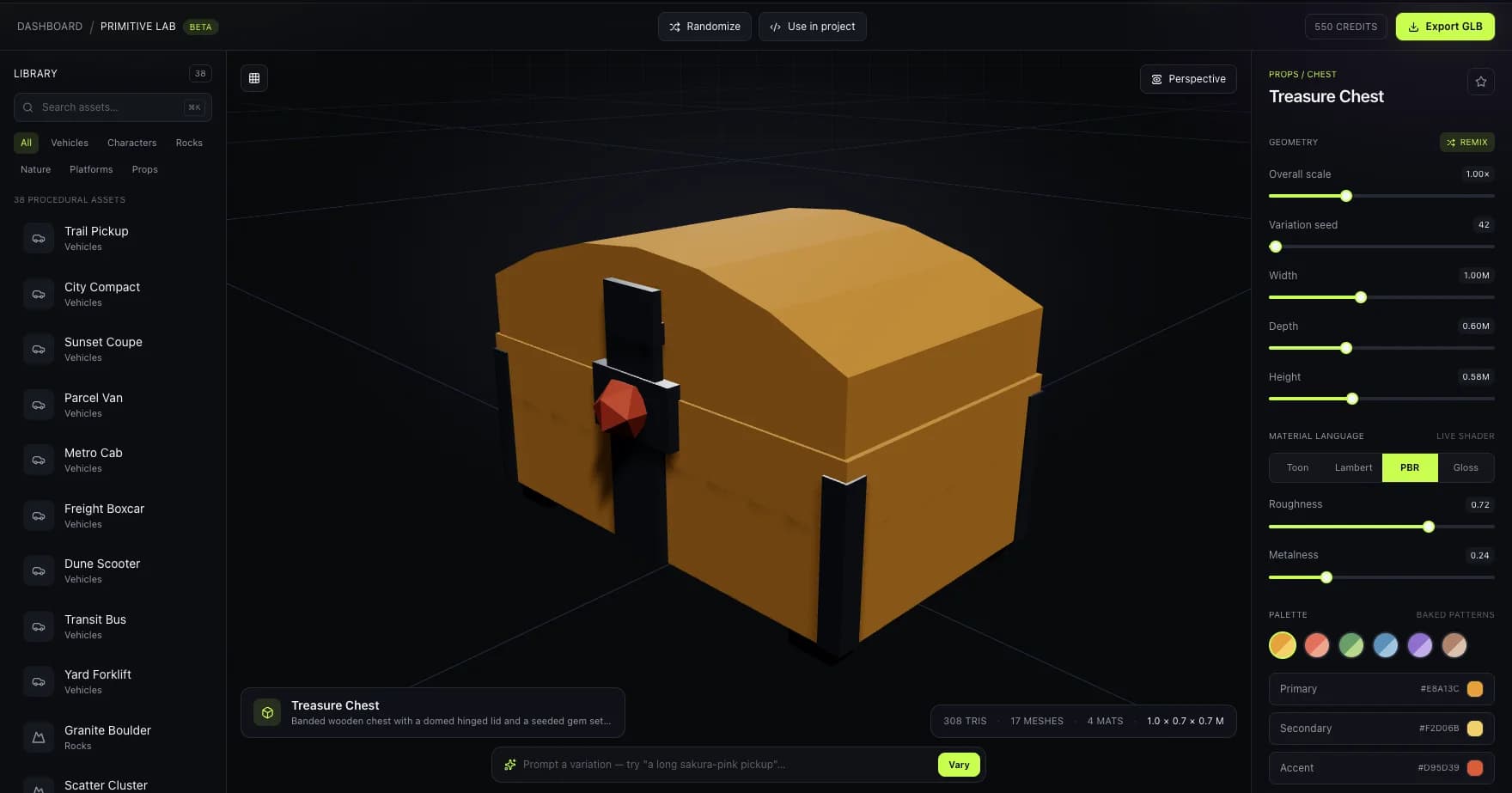
Every asset is deterministic — the same asset, seed, and parameters always rebuild the identical mesh, so a shared seed is effectively a shareable asset file.
NPCs and background characters
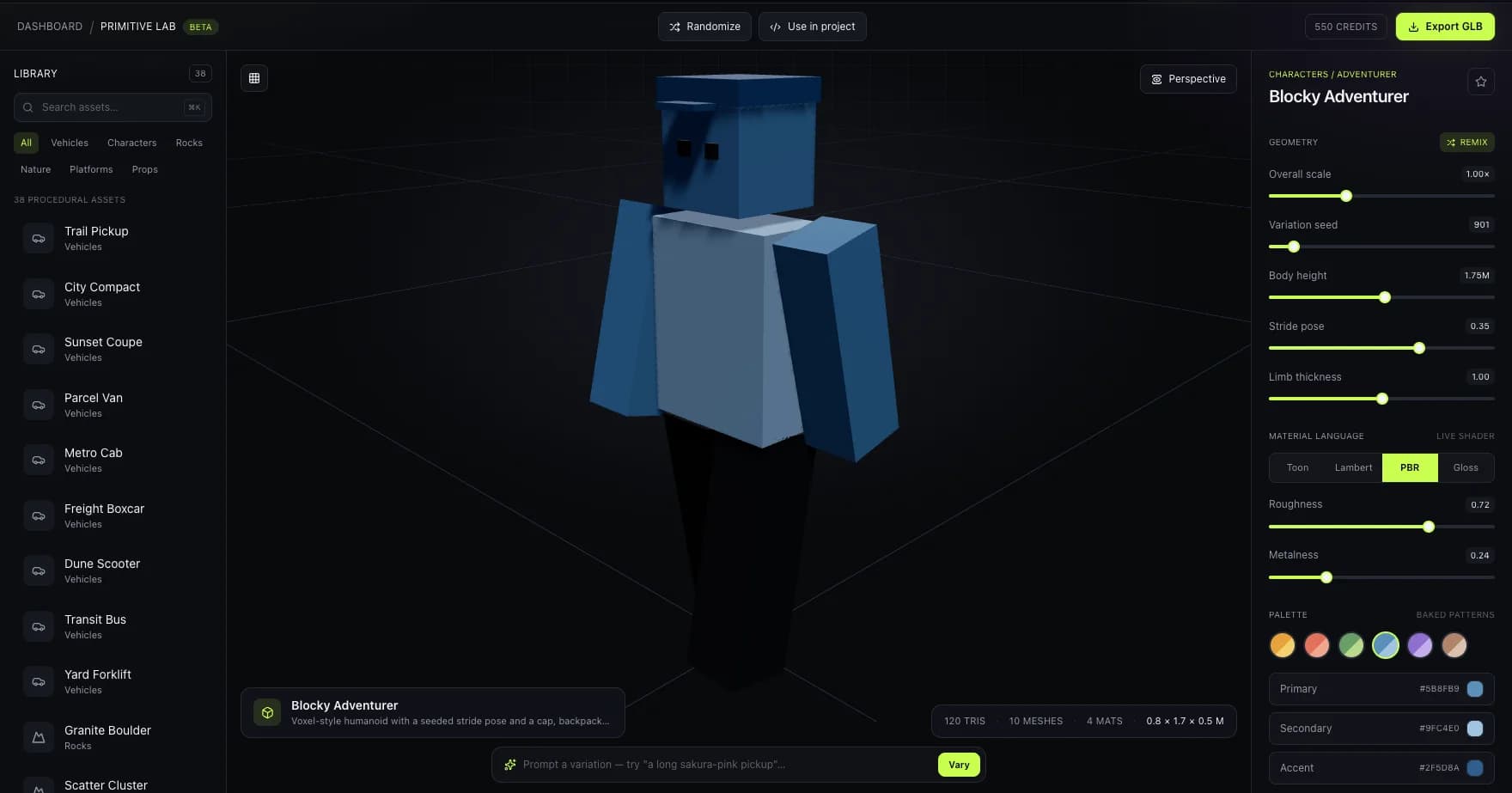
Voxel-style adventurers and robots share one rig with a seeded stride pose, so a crowd of background characters never looks like it was copy-pasted.
Platformer and level design
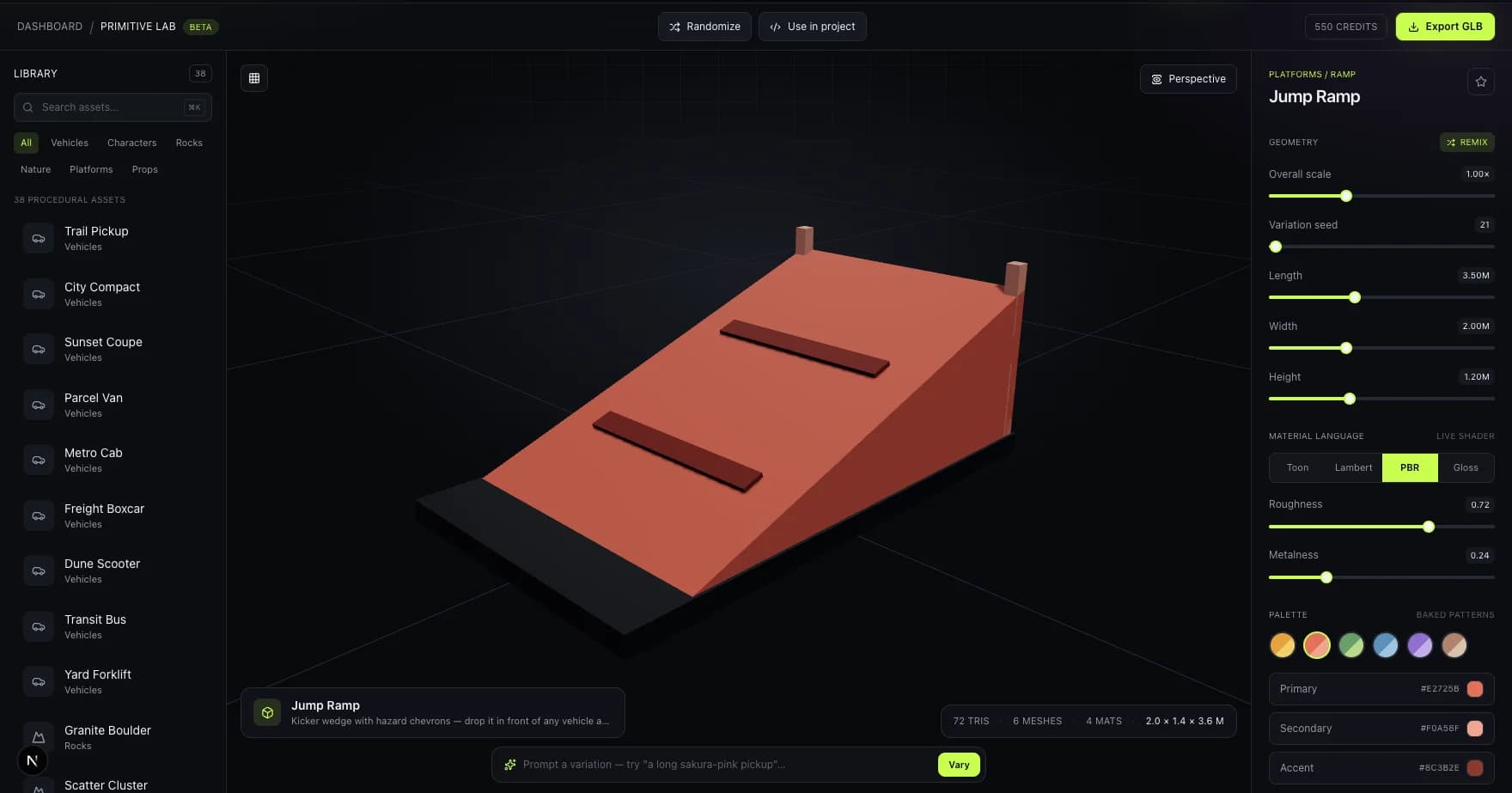
Jump ramps, hover islands, and teleporter pads come with hazard stripes and glowing rims already baked in — drop them straight into a blockout.
Team workspaces
Studio usage rolls up to your organization — invite teammates and see generations, exports, and most-used assets across the team from one dashboard.
faq
Questions, answered
Is Primitive Lab an AI generator?
No — it's procedural and parametric. Every asset is built from code-driven geometry (deforms, noise displacement, lathes) controlled by sliders, not a diffusion model. The same asset, seed, and parameters always rebuild the exact same mesh, which is not something AI generators can guarantee.
Is Primitive Lab free to use?
Yes — it's free for any signed-in user while in beta. Generating and exporting through the studio doesn't spend bunpav credits; those are reserved for the separate text-to-3D and image-to-3D AI pipeline.
What can I export, and does it work in my engine?
One-click binary GLB export, or a ready GLTFLoader code snippet. Every asset is pivot-correct (centered origin, resting on the ground plane) with real-world metre dimensions, so it drops into three.js, Unity, Unreal, or Blender without a cleanup pass.
How many assets are in the library, and can more be added?
61 assets across vehicles, animals, trees, characters, rocks, nature, props, and platforms, with new ones added regularly. The library is registry-driven internally, so growing it doesn't require any changes to the studio UI itself.
Can my team share access and see usage?
Yes. Signing in auto-creates a workspace (or you can name your own), you can invite teammates by email, and the dashboard shows a rolling 30-day usage summary — generations, exports, and the most-used assets — for the whole organization.
Do exported meshes need cleanup before they're game-ready?
Usually not for the two most common problems — pivot placement and scale. Every asset resets to a centered origin, rests on the ground plane, and reports real-world metre dimensions before export. You may still want to add collision volumes in-engine, since Primitive Lab exports visual geometry, not physics colliders.
Can I get the same result twice, or share an asset with a teammate?
Yes — that's the point of the seed system. Send a teammate the asset ID, seed, and slider values (or just the exported GLB) and they can either use the file directly or rebuild the identical mesh themselves in their own session.
How is this different from Meshy, Tripo, or other AI 3D tools?
Those tools (and bunpav's own text-to-3D/image-to-3D pipeline) generate a mesh from a prompt or photo — useful for one-off custom or hero assets, but non-deterministic and not free. Primitive Lab trades that flexibility for instant, free, exactly-reproducible output across a fixed but growing library of common game-object categories.
explore more
Other things bunpav can generate
Primitive Lab covers common game-object categories. For a custom or one-off asset, bunpav's AI pipeline handles the rest.
go deeper