bunpav vs Luma AI (Genie)
bunpav vs Luma AI Genie: fast previews vs rig-and-animate depth
Genie comes from Luma Labs, better known for Dream Machine video generation and earlier NeRF research — a fast, polished 4-variant preview-then-refine flow, but pricing is bundled into Luma's broader subscription rather than sold as its own product. bunpav trades that speed for auto-rig depth and transparent per-tier pricing, though still in private beta. Here's the honest breakdown.
quick answers
The short version
What is Genie, and who makes it?
Genie is Luma Labs' text-to-3D tool. Luma is better known for Dream Machine (AI video generation) and earlier NeRF-based 3D reconstruction research — Genie generates 4 low-resolution preview variants from a prompt in roughly 10 seconds, then lets you Refine your favorite into a higher-quality quad mesh with PBR textures.
Does Genie auto-rig characters like bunpav does?
Not with the same depth. Genie exports quad meshes with PBR textures to .blend, OBJ, FBX, glTF/GLB, and USDZ for Blender, Unity, Unreal, Maya, and Cinema 4D, but it lacks the dedicated auto-rig-and-animate workflow that game-focused tools like bunpav have built specifically for character pipelines.
How much does Genie cost?
There's no dedicated Genie price. It's bundled under Luma's account structure alongside Dream Machine video credits, with Luma Agents subscriptions starting around $30/month — pricing transparency here lags dedicated competitors like Meshy or Tripo that publish a clear price-per-tier page.
Is Genie's speed worth it over bunpav's auto-rig?
Depends on the task. If you're fast-concepting shapes and want 4 variants in 10 seconds before committing, Genie is genuinely strong at that. If you need a character rigged and ready to animate in the same pass, bunpav is built specifically for that job — Genie isn't.
side by side
Full comparison
| Dimension | bunpav | Luma AI (Genie) |
|---|---|---|
| Availability | Private beta, waitlist-gated | Publicly self-serve today |
| Core business | Dedicated 3D generation and auto-rig product | Luma Labs — best known for Dream Machine (video) and NeRF-based 3D research |
| Generation flow | Text-to-3D and image-to-3D, single generation with auto-rig | 4 low-res preview variants in ~10s, then Refine one into a higher-quality quad mesh |
| Rigging & animation | Auto-rig humanoid/creature skeleton in the same generation pass | Not a dedicated auto-rig-and-animate workflow |
| Access points | Web (private beta) | Web, iOS app, and Discord |
| Pricing clarity | Published prepaid packs: $9/100, $39/550, $89/1,500 credits | Bundled with Dream Machine video credits; Luma Agents subscriptions start around $30/mo |
| Export formats | GLB, FBX, OBJ, USDZ, STL | .blend, OBJ, FBX, glTF/GLB, USDZ for Blender, Unity, Unreal, Maya, Cinema 4D |
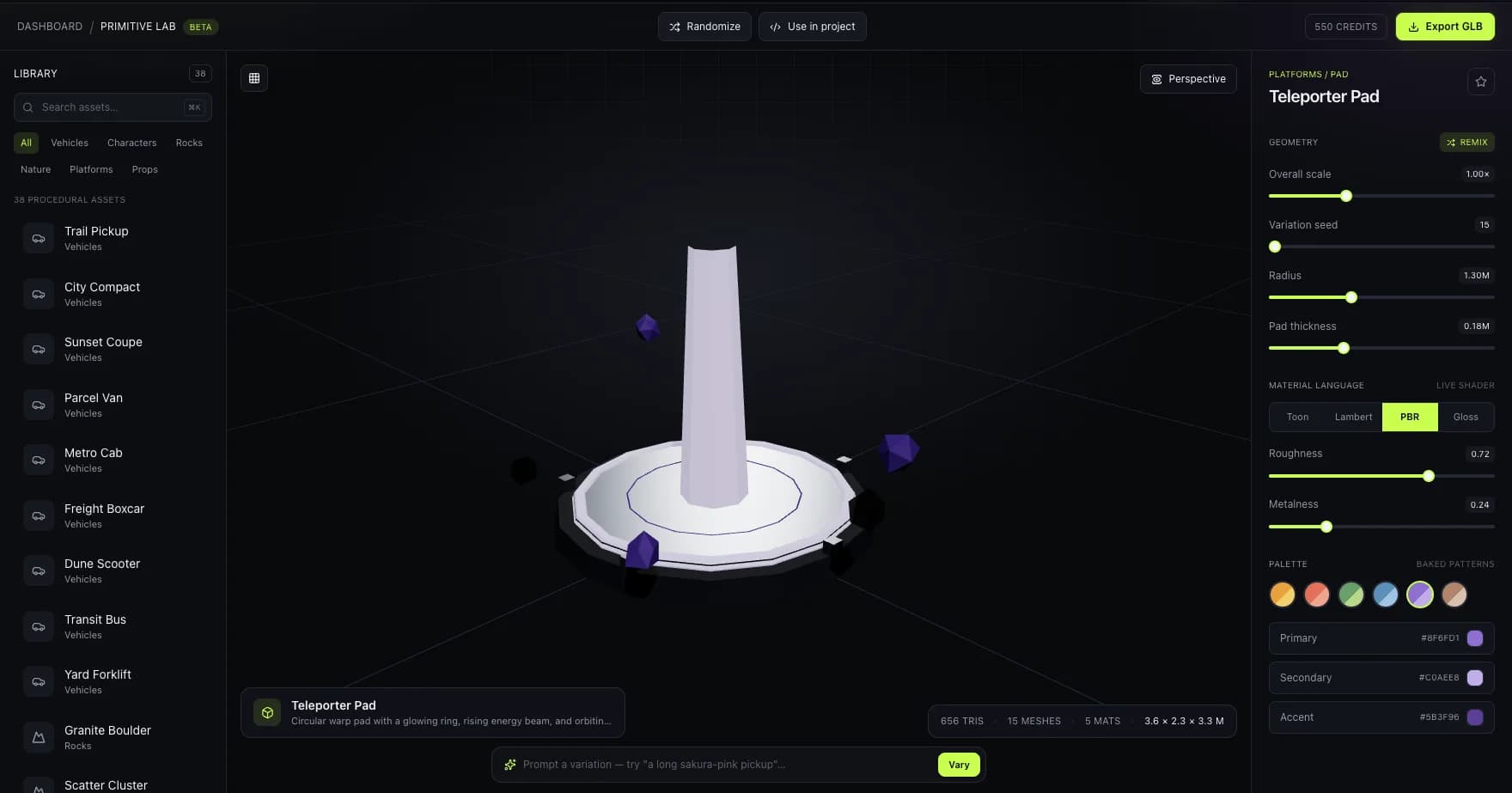
A real Primitive Lab capture of the in-browser review step every bunpav asset goes through — a contrast to Genie's fast 4-variant preview-then-refine flow.
where bunpav wins
Auto-rig is a first-class feature
bunpav rigs a humanoid or creature skeleton in the same generation pass. Genie is strong at fast-concepting shapes but lacks that dedicated rig-and-animate depth.
Transparent, dedicated pricing
bunpav publishes a clear price-per-tier structure for 3D generation specifically. Genie's pricing is bundled into Luma's broader account structure alongside Dream Machine video credits, without a clean dedicated price.
where Luma AI (Genie) wins
A fast, polished preview-then-refine flow
4 variants in about 10 seconds is a genuinely strong way to fast-concept shapes before committing to a higher-quality Refine pass.
You can use it right now, on more surfaces
Genie is publicly available via web, iOS app, and Discord. bunpav is still gated behind a private-beta waitlist.
who should pick which
Match the tool to the job
Pick Luma AI Genie if
You want to fast-concept shapes with 4 variants in seconds, are fine using it via web, iOS, or Discord, and don't need a dedicated rig-and-animate step baked in.
Join the bunpav waitlist if
You need auto-rig built into generation, transparent per-tier credit pricing instead of a bundled video subscription, and can wait on beta access.
faq
Questions, answered
What company makes Genie, and what's their main product?
Genie comes from Luma Labs, a company better known for Dream Machine (AI video generation) and earlier NeRF-based 3D reconstruction research. Genie is their text-to-3D tool, not the company's flagship product.
How does Genie's generation flow work?
You enter a text prompt and Genie generates 4 low-resolution preview variants in roughly 10 seconds. You then pick your favorite and run a Refine pass to get a higher-quality quad mesh with PBR textures.
What formats does Genie export to?
Genie exports as .blend, OBJ, FBX, glTF/GLB, and USDZ, covering Blender, Unity, Unreal, Maya, and Cinema 4D. bunpav exports GLB, FBX, OBJ, USDZ, and STL, adding 3D-printing support that Genie's list doesn't call out.
Why doesn't Luma publish a clear Genie price?
Genie's pricing isn't broken out as its own dedicated product — it's bundled under Luma's account structure alongside Dream Machine video credits, with Luma Agents subscriptions starting around $30/month. That pricing transparency lags dedicated competitors like Meshy or Tripo that publish a clear price-per-tier page.
Does Genie rig characters for animation the way bunpav does?
No, not with the same depth. Genie is a strong fast-concepting tool from a video-first company, but it lacks the dedicated auto-rig-and-animate workflow that game-focused tools have built out. bunpav auto-rigs a humanoid or creature skeleton in the same generation pass.
go deeper