step 01
Choose a game kit
Start from an arcade, adventure, survival, or strategy ruleset. Each kit combines a movement model, objectives, hazards, pickups, and a matching visual system.
Game Lab · playable beta
Choose a game kit, tune its rules and seed, then play the generated level in your browser. No build step and no hand-placing the first hundred obstacles.
from rules to runtime
step 01
Start from an arcade, adventure, survival, or strategy ruleset. Each kit combines a movement model, objectives, hazards, pickups, and a matching visual system.
step 02
Adjust difficulty, map size, enemy density, game speed, pickup count, palette, and the deterministic seed. Every change rebuilds the playable level immediately.
step 03
Use WASD or the arrow keys in the live viewport. Collect shards, avoid moving hazards, and reach the portal without leaving the generation environment.
step 04
Download a compact JSON recipe containing the template, seed, and rule configuration. The same recipe recreates the same game layout for teammates and future builds.
real studio screenshots
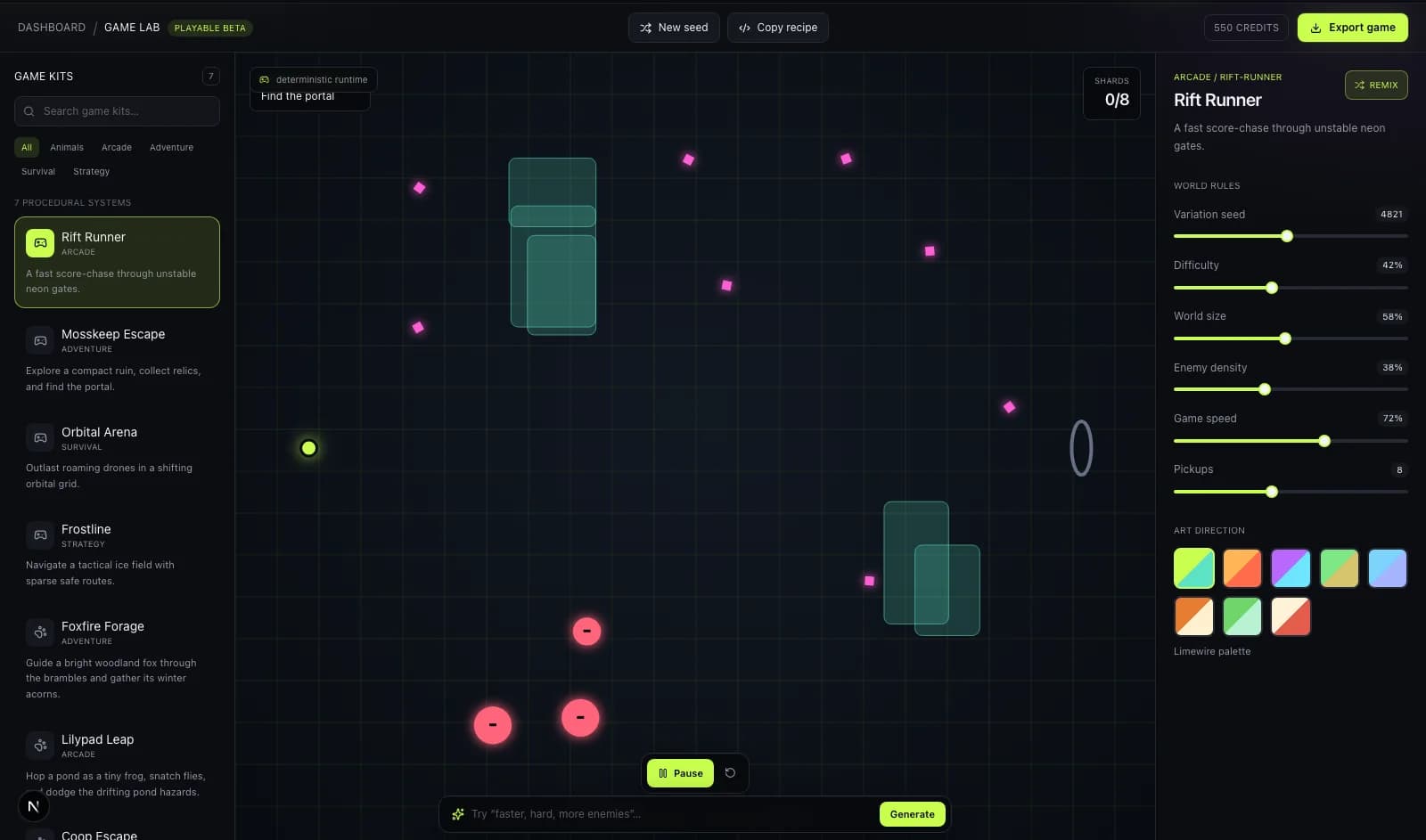
Both captures come from the live Game Lab beta and are cropped to the product workspace. The mapping is deliberate: Rift Runner demonstrates arcade pacing; Mosskeep Escape demonstrates adventure objectives and a different palette.
Rift Runner: arcade rules under live control
Tune seed, world size, difficulty, enemies, speed, pickups, and palette while the playable arena rebuilds in place.
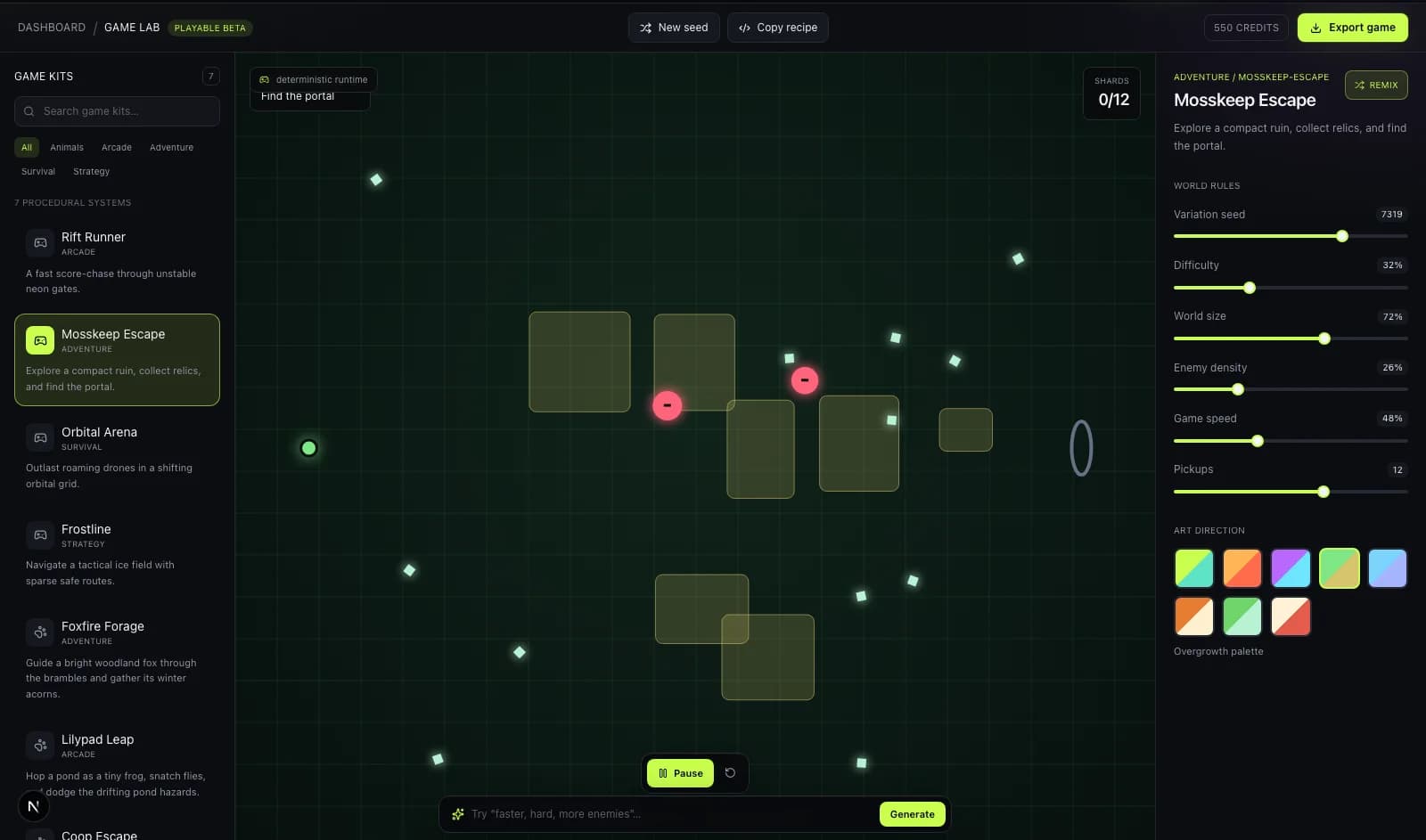
Mosskeep Escape: the same system, a different kit
A second real studio capture maps the same deterministic rule controls to an adventure layout and a separate visual system.
one seed, one exact world
Game Lab uses deterministic seeded generation. A template defines the mechanics; your controls define the density and pacing; the seed locks the result. Share those values and another developer gets the same obstacle layout, pickups, enemies, and exit position.
built for fast iteration
Find a fun pacing baseline before a small team spends the jam placing level content or building a custom editor.
Compare difficulty, density, speed, and objective changes inside the playable loop instead of debating them in a design document.
Show how templates, constrained parameters, and deterministic seeds turn algorithms into reproducible game spaces.
go deeper
procedural game generator faq
A procedural game generator creates game rules and level content from a deterministic algorithm instead of requiring every obstacle, enemy, and pickup to be placed by hand. In bunpav Game Lab, a template, seed, and configuration combine into a playable browser level.
It generates a playable level in the browser. You can move with WASD or the arrow keys, collect objectives, avoid enemies, unlock the exit portal, pause the runtime, and reset the current build directly inside the studio.
Deterministic generation means the same template, seed, and rule values produce the same level layout. That makes a generated build reproducible: a teammate can load the recipe and work from the identical world rather than a visually similar approximation.
Yes. The inspector exposes difficulty, world size, enemy density, speed, pickup count, and multiple color systems. The prompt bar also understands directions such as faster, easy, hard, peaceful, or more enemies.
Game Lab is designed for indie developers, game-jam teams, designers testing mechanics, and educators teaching procedural generation. It is especially useful when the first goal is a playable ruleset rather than production art.
Game Lab is available to signed-in bunpav users during the playable beta. The studio shows your shared account balance, but generating and exporting procedural game recipes does not currently consume AI generation credits.